Authors: Mariam Al-E’bayat1, Diya Ali Alfuqara2, Hadeel Abu Hamam2, Sereen Amra2, Dana Abuhamad2, Rimeen Hamdan2 and Ashraf Alsafasfeh*2,3
DOI: https://doi.org/10.48103/jjeci9102026
JORDANIAN JOURNAL OF ENGINEERING AND CHEMICAL INDUSTRIES (JJECI)
Pages: 138- 148

Abstract
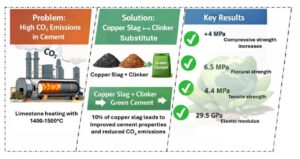
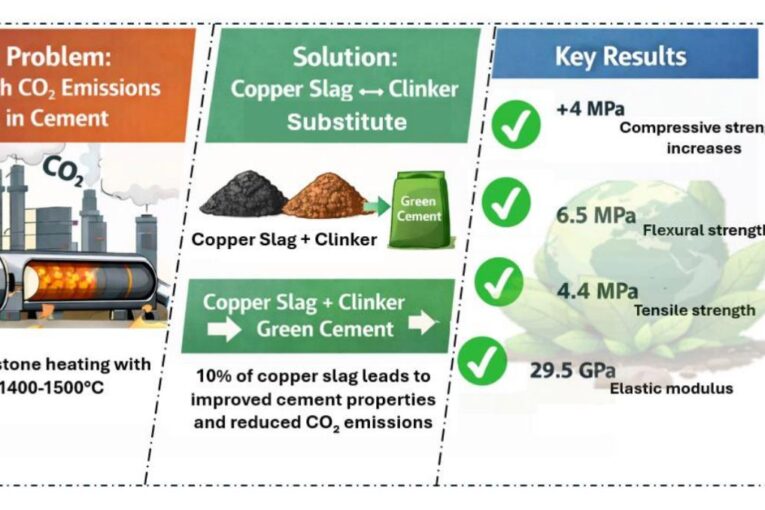
The increasing demand for cement leads to higher global CO₂ emissions from heating limestone to produce clinker. Researchers and plant managers are seeking to overcome this challenge by reducing clinker content through alternative materials, which could lower environmental impact and improve cement properties. This study investigates the potential of using copper slag as a partial replacement for clinker in cement production. Five mixtures of clinker-copper slag ratios were prepared, mixed, cured, and then tested to evaluate the effects of adding the copper slag at the expense of clinker. These include compressive strength, flexural, tensile, and elastic modulus tests, as well as setting time measurements. The results were then compared with a baseline mixture that was prepared to represent a standard cement composition. The results show that 10% copper slag, at the expense of clinker, increases the cement compressive strength by +4 MPa compared to the baseline in the long-term test. Other mechanical properties results show an improvement in the cement production. As an example, flexural strength increased to 6.5 MPa, tensile strength increased to 4.4 MPa, and elastic modulus increased to 29.5 GPa compared to 6.2 MPa, 4.1 MPa, and 28.5 GPa in the baseline mixture, respectively.
Paper type: Research Paper.
Keywords: Copper slag, CO₂ reduction, Cement, Clinker replacement
Citation: Al-E’bayat, M., Alfuqara, D. A., Abu Hamam, H., Amra, S., Abuhamad, D., Hamdan, R., and Alsafasfeh, A.” Utilization of Copper Slag as a Partial Clinker Replacement Material in Cement Production” Jordanian Journal of Engineering and Chemical Industries, Vol. 9, No.2, pp: 138-148 (2026). DOI: https://doi.org/10.48103/jjeci9102026