Authors: Mohammed Salem El-Ali Al-Waqfi
DOI: https://doi.org/10.48103/jjeci912026
JORDANIAN JOURNAL OF ENGINEERING AND CHEMICAL INDUSTRIES (JJECI)
Pages: 1- 11

Abstract
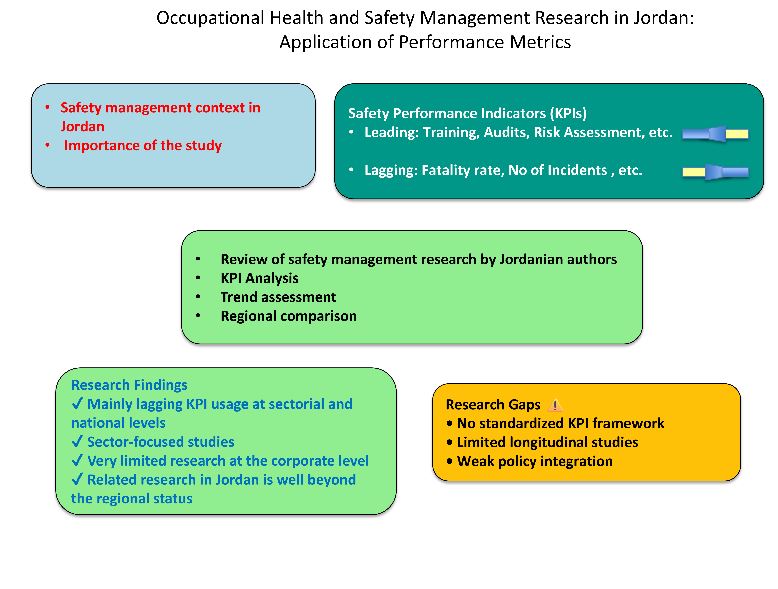
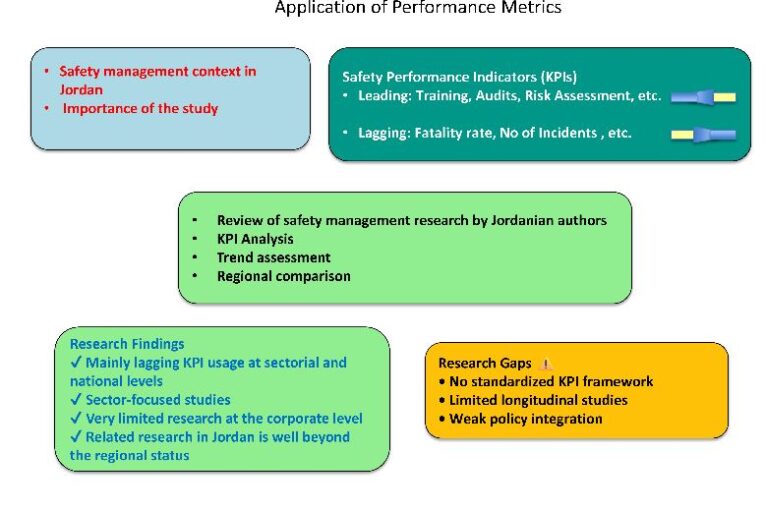
Safety incidents worldwide result in the loss of millions of dollars yearly, primarily due to medical treatment costs, injury settlements, and production delays. Enhancing work conditions and applying safe practices can significantly lessen such costs. Thus, creating safety monitoring and management schemes to evaluate safety performance using quantitative metrics (i.e., Leading and Lagging Performance Indicators) is crucial. Lagging indicators measure previous performance and may establish performance patterns. While, leading indicators are forward-predicting and protective metrics that allow deeper look into the adequacy of safety practices and identify potential related issues. Using a combination of lagging and leading PIs to gauge safety performance has become a standard practice in industries. This paper examined the literature on safety management, concentrating on using leading and lagging performance indicators across different sectors. The review explored how these indicators influence the efficacy of safety management, with a particular emphasis on research conducted by Jordan researchers. The findings revealed a significant gap in research on performance measurement at the corporate level among Jordanian researchers. Specifically, leading indicators are notably absent from local studies, while lagging indicators are mainly found in national-level and sector-specific research, primarily used to evaluate past performance.
Paper type: Review paper
Keywords: Occupational health and safety management, Safety performance metrics, Lagging indicators, Leading indicators, Process safety.
Citation: Al-Waqfi, M. El-Ali “Occupational Health and Safety Management Research in Jordan: Application of Performance Metrics” Jordanian Journal of Engineering and Chemical Industries, Vol. 9, No.1, pp:1-11 (2026).