Authors: Mohammad Ben Tarief , Sakher Alaqbawe, Suleiman Abu-Ein.
DOI: https://doi.org/10.48103/jjeci8172025
JORDANIAN JOURNAL OF ENGINEERING AND CHEMICAL INDUSTRIES (JJECI)
Pages: : 163-175

Abstract
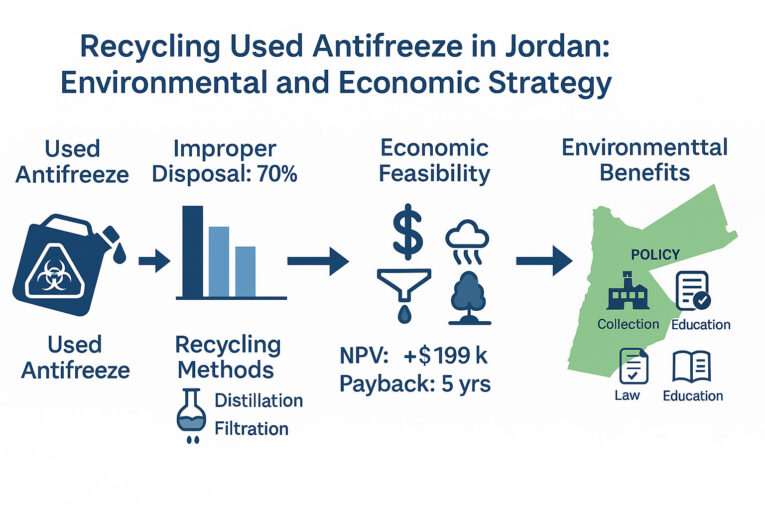
Antifreeze, primarily composed of ethylene glycol, is essential for automotive cooling systems but poses serious environmental and health risks when improperly disposed. In Jordan, field surveys across 100 workshops revealed that over 70% of used coolant is discharged directly into drains or the environment, with 85% of the public unaware of its toxicity. This paper presents a case study of Jordan’s coolant waste issue and proposes a national recycling framework. A techno-economic analysis shows that regenerated antifreeze can be produced at $180–270 per ton, with positive NPV over 10 years and 5 years payback period. Several recycling methods were compared in terms of cost, purity, and environmental impact. An environmental impact assessment, aligned with ISO 14001, was conducted, and a logistics model for intermediate recycling facilities was proposed for five major cities. The study concludes with policy recommendations including regulatory reform, public awareness campaigns, and environmental taxes to support system implementation.
Paper type: Research Paper
Keywords: Toxic chemical disposal, Automotive antifreeze, Ethylene glycol, Environmental hazards, Sustainable waste management.
Citation: Ben Tarief, M., Alaqbawe, S., Abu-Ein, S., “Toxic Coolants and Sustainable Solutions: A Jordanian Case Study on Ethylene Glycol Waste, Environmental Impact, and Policy” Jordanian Journal of Engineering and Chemical Industries, Vol. 8, No.2, pp:163-175 (2025).