Authors: Ziad Abu El-Rub, Nadine Nassar, Noor Shuqum and Rama Al-Junaidi
DOI: https://doi.org/10.48103/jjeci8162025
JORDANIAN JOURNAL OF ENGINEERING AND CHEMICAL INDUSTRIES (JJECI)
Pages: : 176-190

Highlights
- Evaluates three major LIB recycling methods: hydro-, pyro-, and direct routes
- Direct recycling offers 40–60% lower environmental impact than other methods
- Hybrid recycling enhances recovery rates and reduces energy and emissions.
Abstract
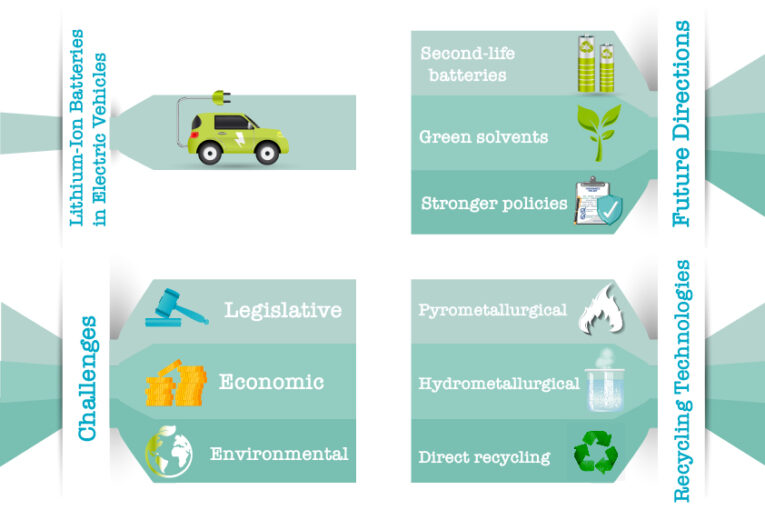
One important element of international efforts to reduce carbon emissions is electric vehicles, or EVs. However, the management of lithium-ion batteries (LIBs) after their service life is becoming a bigger challenge due to their quick adoption. The need for effective and scalable recycling solutions is growing as millions of EV batteries approach retirement. The three main recycling pathways: hydrometallurgical, pyrometallurgical, and direct recycling, are examined in this review paper along with their advantages, disadvantages, and sustainability. Hydrometallurgy can recover precious metals like cobalt and lithium at high rates, but there are complications with chemical use, wastewater production, and process complexity. Pyrometallurgy is a well-established industrial process, but it conumes high energy, produces metal losses, and has a low lithium recovery rate. The variety of battery types and technological immaturity continue to limit the acceptance of direct recycling, despite the fact that it has emerged as a viable option that aims to recover usable elements with minimal processing. This review highlights the economic and legislative obstacles, including the absence of design-for-recycling guidelines, high operating costs, and volatile raw material markets. The management of hazardous waste, emissions from recycling activities, and the environmental impacts of battery manufacturing are also covered.The review concludes with an outlook on green solvents, hybrid recycling solutions, second-life uses, and legislative frameworks that promote the ideas of the circular economy. This study provides direction for researchers, policymakers, and industry stakeholders working toward sustainable lithium-ion battery recycling systems that are in line with resource security and climate goals by highlighting recent developments and highlighting important research needs.
Paper type: Review paper
Keywords: Lithium-ion batteries, battery recycling, electric vehicles, sustainable technologies, circular economy.
Citation: Abu El-Rub, Z., N., Nassar, N., Shuqum, and R. Al-Juaniadi” Recycling Technologies for Lithium-Ion Batteries in Electric Vehicles: A Critical Review” Jordanian Journal of Engineering and Chemical Industries, Vol. 8, No.2, pp:176-190 (2025).