Authors: Soraya Mercedes Pérez
DOI: https://doi.org/10.48103/jjeci8192025
JORDANIAN JOURNAL OF ENGINEERING AND CHEMICAL INDUSTRIES (JJECI)
Pages: : 191-200

Abstract
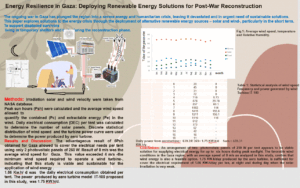
The ongoing war in Gaza has plunged the region into a severe energy and humanitarian crisis, leaving it desvasted and in urgent need of sustainable solutions. This study investigates the potential of combined renewable energy sources -solar and wind- to address the areas’s critical energy needs. Irradiation solar and wind velocity were taken from NASA database. Peak sun hours (Psh) were calculated and the average wind speed allowed to quantify the contained energy (Pc) in the wind. Pc results are adjusted, using the power coefficient (Np), to obtain the maximum extractable energy of wind energy (Pe). Daily electrical consumption (DEC) and Daily array size (DAS) of a basic tent was determined together with the number of solar panels necessary to cover this consumption, during Psh. A wind turbine model IT-100 used in rural areas of Perú and Sri Lanka, economical and easy to build, was chosen to provide electrical energy as an alternative to the solar array. Discrete statistical distribution of wind speed and the turbine power curve were used to determine the energy produced by aeroturbine. The results revealed that average speed of wind around 8.1 m/s, indicate that is feasible the use of eolic energy. Other parameters as Relative humidity (68.2%), wet (17.96 oC) and dry temperature (21.91 oC), also were measured. DEC and DAS found per tent were 1.66KW.h/d and 0.42 KW respectively. Two solar panels of 250 W are needed to cover DEC per tent. Comparing the results of Pe (209.89 W) and Pc (723.7 W), as expected, Pe was lower than Betz limit. Results of the energy generated annually (PG) and daily (DEEA) for aerogenerator were 639.3 W.h/y and 1.75 KW.h/d respectively. This work concludes that the solar array is efficient and can cover the electrical needs of a basic tent during Psh. At night and during the day when the photovoltaic array operates inefficiently due to the lack Psh, the aeroturbine analised in this study is capable of supplying the electrical equipments being utilized.
Paper type: Research Paper
Keywords: Betz limit, Aeroturbine, Power number, Solar arrangement, Peak sun hours
Citation: Pérez, S. M. “Energy Resilience en Gaza: Deploying Renewable Energy Solutions for Post-War Reconstruction”, Jordanian Journal of Engineering and Chemical Industries, Vol. 8, No.2, pp:191-200 (2025).