Authors: Soraya Mercedes Pérez , Amal Al-Hanaktah and Suhail Sharadqah
DOI: https://doi.org/10.48103/jjeci8242025
JORDANIAN JOURNAL OF ENGINEERING AND CHEMICAL INDUSTRIES (JJECI)
Pages: : 247-257


Highlights
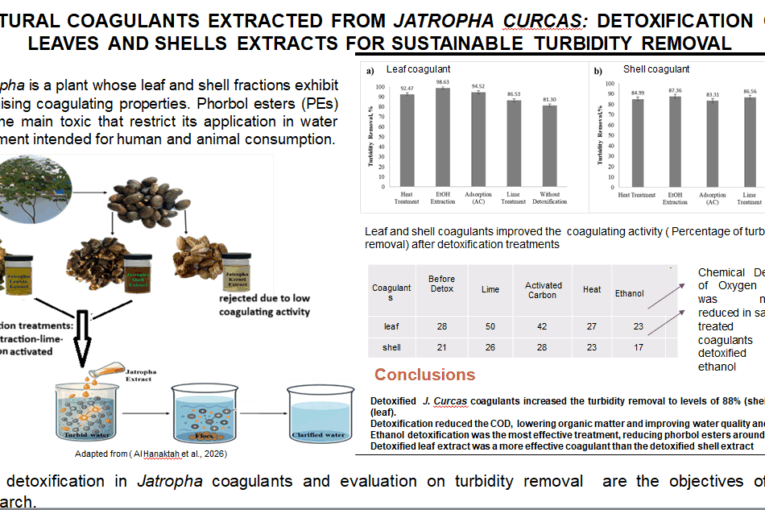
- A new type of coagulant derived from Jatropha, in the form of aqueous extracts detoxified from phorbol esters, was investigated for its effectiveness in reducing turbidity in water intended for human and animal consumption.
- The application of physical and chemical methods for the reduction of toxic phorbol esters enhanced the coagulating activity, increasing the turbidity removal efficiency from 76% to 88% for shell-based coagulants, and from 81% to 98% for leaf-based coagulants
- Detoxification of Jatropha-based coagulants also contributed to the reduction of organic matter, as evidenced by a decrease in chemical oxygen demand (COD) to levels as low as 17 ppm, thereby improving the quality and safety of the treated water.
- Ethanol extraction was the most effective detoxification method among those proposed in this study, achieving up to a 53% reduction in phorbol esters.
Abstract
Jatropha is a plant whose leaf and shell fractions exhibit promising coagulating properties. Phorbol esters (PEs) —constituted 12-deoxy-16-hydroxy phorbol as core structure—, is the main toxic that restrict its application in water treatment intended for human and animal consumption. PEs detoxification in Jatropha coagulant extracts, their effect on Turbidity removal (coagulating activity) and Chemical Oxygen Demand (COD) was investigated in synthetic samples of wastewater. Additionally, coagulating activity was evaluated in samples of different turbidity (tap water, Dead Sea water and groundwater), which were treated with the best detoxified coagulants. Detoxification was performed through ethanol extraction, adsorption with activated carbon, thermal and lime treatments. Finding that detoxification exerted a positive effect, enhancing turbidity removal to levels between 87% to 98%. Particularly for ethanol-detoxified leaf extract, which was able to reduce by 98.6% turbidity, 53% PEs and COD 18%. Even for samples of different turbidity, the assessment of coagulating activity revealed that the detoxified extracts by ethanol, especially leaf coagulants, were better coagulants than other ones detoxified by another treatments. Improving significantly the turbidity removal efficiency (17%), even under saline stress and in the presence of natural minerals, as observed in tap and Dead Sea water. The innovative application of coagulant extracts, chemical-free and detoxified using environmentally friendly methods, renders this approach novel, sustainable and feasible. The findings led to conclude that Jatropha coagulants applied as aqueous liquid extracts facilitate the detoxification (PEs removal and other hydrophobic toxins), enhancing the coagulating activity. Discovering that the detoxified leaf extract is a more efficient coagulant than the shell extract. Being detoxification by ethanol the best treatment among those analysed in this study.
Paper type: Research Paper
Keywords: Coagulating activity, Dead sea, COD, phorbol esters, wastewater
Citation: Pérez, S. M., A., Al-Hanaktah, and S. Sharadqah “Detoxification of Natural Coagulants Extracted from Jatropha Curcas Leaves and Shells for Sustanaible Turbidity Removal” Jordanian Journal of Engineering and Chemical Industries, Vol. 8, No.3, pp:247-257 (2025).