Authors:Etab Taha AL Kasasbeh , Wasan AL Maaitah, Ruba T. AL Kasasbeh, Ashraf Shaqadan, Osama Al-Habahbehe
DOI: https://doi.org/10.48103/jjeci8252025
JORDANIAN JOURNAL OF ENGINEERING AND CHEMICAL INDUSTRIES (JJECI)
Pages: : 227-246


Highlights
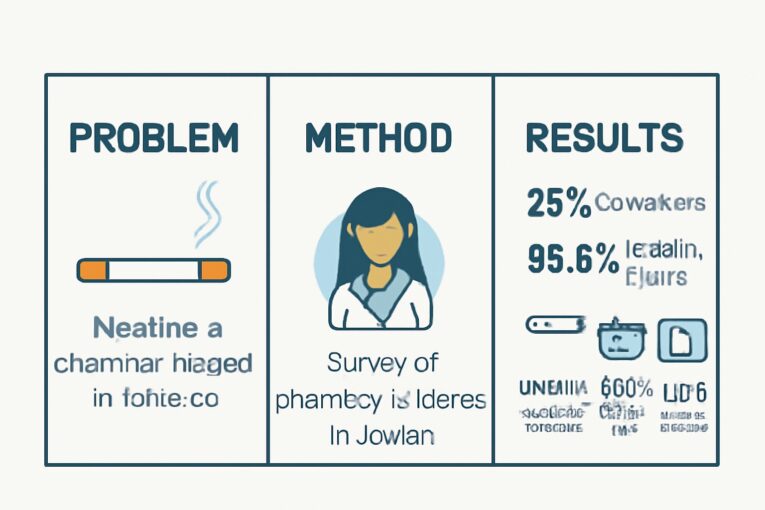
- Study examined smoking prevalence, attitudes, and cessation strategies among 822 pharmacy students at Balqa Applied University, Jordan (Jan 2022–Jan 2023).
- 25% of participants were non-smokers; 93.6% recognized the health risks of smoking.
- Common cessation methods used were electronic cigarettes (44.4%), nicotine gum (13.3%), and nicotine patches (6.0%), while 30.8% were unaware of available cessation options.
- Neural network models were effective in detecting rare cessation strategies and identifying individuals at higher risk of cessation failure, aiding targeted interventions.
Abstract
Nicotine, a primary chemical hazard in tobacco, presents severe health risks, including addiction and chronic diseases. This study employs a biostatistics and machine learning framework to analyze smoking prevalence, beliefs, and attitudes toward smoking cessation among pharmacy students at Balqa Applied University, Al-Kerak University College, Jordan. A cross-sectional survey was conducted from January 2022 to January 2023, involving 822 participants. Smoking behaviors, perceptions of nicotine’s health effects, and cessation knowledge were assessed using descriptive and inferential statistics with SPSS (version 26). In addition, Random Forest (RF) and fully connected Neural Network (NN) models were developed, supported by SMOTE for class imbalance, to predict smoking status and cessation engagement. Results showed that 25% of students were non-smokers, and 93.6% acknowledged smoking’s health risks. Common cessation methods included electronic cigarettes (44.4%), nicotine gum (13.3%), and nicotine patches (6.0%), whereas 30.8% were unaware of any cessation strategies. Furthermore, 79.4% supported specialist clinics for quitting, 81.3% endorsed public smoking bans, and 88.7% favored restricting tobacco sales to minors. Age and gender emerged as significant predictors of smoking prevalence and cessation engagement (p = 0.0001). Comparative modeling indicated that RF achieved superior overall prediction accuracy, while NN models better detected rare cessation strategies and identified individuals at higher risk of treatment failure. These findings highlight the value of integrating biostatistics and machine learning in public health research and reinforce the need to strengthen smoking cessation education in pharmacy curricula.
Paper type: Research paper
Keywords: Nicotine , Smoking , Smoking Cessation , Pharmacy Students , Jordan, Nicotine Risk
Citation: AL Kasasbeh EA, AL Maaitah W, AL Kasasbeh R T., Shaqadan Ashraf, Al-Habahbeh O , ” Nicotine as A Hazardous Chemical and Smoking Behaviors and Cessation Strategies among Pharmacy Students in Jordan: Chemical and Statistical and Machine Learning Approach ” Jordanian Journal of Engineering and Chemical Industries, Vol. 8 No.3, pp:227-246 (2025).